
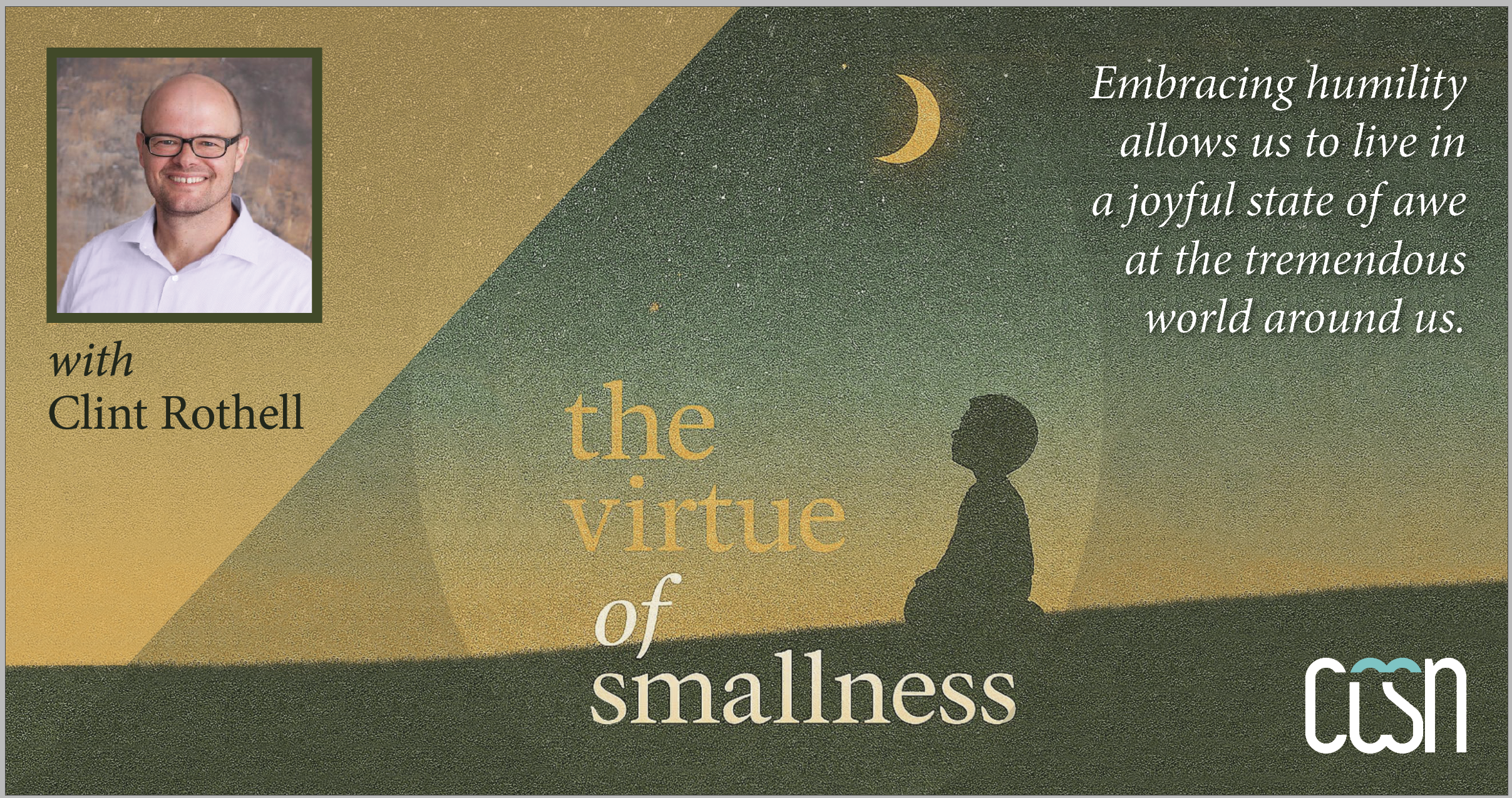
Column entry: Smallness in Christ
Column Description: Pride is the childish pursuit of making the world, our family, friends, colleagues, and strangers small so that we can become large and more important. In this column, I focus on pride’s opposite: humility. In contrast to pride, humility is being in right proportion with the universe. Humility is the childlike pursuit of choosing to become small, so the world, our family, our friends, and everyone can become large to us again. By choosing to become small, we can live in a joyful state of awe at the tremendous world around us. This will inspire our curiosity and wonder because we want to know more about this awesome world, son, daughter, friend, colleague, or stranger before us. Practicing the virtue of smallness leads to a heart of worship and adoration, love and gratitude, joy and contentment.
February, 2026 | September 2025
Smallness in Christ
Who has measured the waters in the hollow of his hand, or with the breadth of his hand marked off the heavens? Isaiah 40:12 (NIV84)
What is the size of the universe? When it comes to units of measurement, I am accustomed to using inches, feet, and miles. However, I was reminded recently that one of the units of measurement within our solar system is an astronomical unit, measuring 93 million miles.
Recently, I bought several 2x4s that measure 96 inches long for a chicken coop I am building. But 93 million miles?
That’s 93 with six 0s after it.
And as everyone reading this knows, the Earth orbits roughly 93 million miles from the sun. Amazingly, it takes just over 8 minutes for the sun’s light to travel to reach the Earth, because, naturally, it is traveling at the speed of light. If we translate the speed of light to miles per hour, that’s 670.6 million mph.
Wow.
Let’s say there was a highway to the sun with a speed limit of 75 mph. If you obeyed the speed limit, it would take you 141.5 years to get to the sun. If the flow of traffic was 85 mph, you could shave off just over 16 years. Sadly, either way, you would die before you arrived at your destination.
When you move on to the observable universe, astronomers estimate that it is 92 billion light-years across. One light year is equivalent to 5.88 trillion miles. Okay, so now, all we have to do is multiply 5.88 trillion miles by 92 billion, which equals 540,960,000,000,000,000,000,000 miles, or 540,960 sextillion miles.
We are not done, because we have only considered the universe’s horizon. This is what we can observe through a telescope. So, we do not know what the actual size of the universe is. However, we do know the universe is expanding…at an accelerating rate.
I think I want to work on my chicken coop again.
The vastness of the universe reminds of how powerful God is. I feel a sense of smallness where I am closer to being rightly sized with God and his world. I also have this mystical feeling of being both astonished and terrified all at once when I am reminded that God spoke the universe into existence (Psalm 33:6-9) and “marked off the heavens “with the breadth of His hand” (Is. 40:12). I realize that because God created this vast universe, it does not imply that God is outrageously large himself. God is not large like the ocean is large. As an immaterial being, God is not in the universe like the ocean is in the universe. However, the God of the Universe does seem “big enough” in J. B. Phillips’ words to “command (my) highest admiration and respect…”[1]
The Bible gives some strong clues about God’s immensity when it uses metaphors of God stretching out the heavens with his hand like Isaiah 40:12 above or when God says “Heaven is my throne and the earth is my footstool” (Isaiah 66:1). In addition, King Solomon says the following in his prayer dedicating the Temple, “But will God really dwell on earth? The heavens, even the highest heaven, cannot contain you. How much less this temple I have built!” (1 Kings 8:27).
When I think about God’s humility becoming human, I can’t help but think that when Solomon asked, “Will God really dwell on earth?” God smiled and whispered to himself, “Just wait.”
One day, God would begin to reveal “the mystery” he had “kept hidden for generations” (Col 1:26). God himself would dwell on earth, but not in a temple. The God who delights in surprising us would become even smaller. “The infinite (would) become an infant,”[2] allowing himself to be contained in Mary’s womb. In the incarnation, God not only submitted to learn to talk, crawl, walk, read, write, but he also decided to be vulnerable by receiving comfort, love, lullabies, and even a diaper change.
Not that God ceased being who he is, but he came to us as we are. God did not lose his divinity; he took on humanity. All of it.
So, why does this matter to me? Because while the universe makes me feel small and insignificant, the incarnation makes me feel loved. The incarnation assures me that the God of constellations, oceans, and mountains cared enough to relate to my frustrations, sufferings, disappointments, and griefs. In the incarnation, God reveals to me that he would do anything to make me right with him, because he loves me.
I can’t be swallowed by the universe’s vastness, because I am elevated by God’s smallness. He has given me the gift of joyful awe and gratitude from being rightly sized with His universe.
Notes
[1] J. B. Phillips, Your God is Too Small (New York: Macmillian Publishing, Inc. 1979), 8.
[2] C. H. Spurgeon, “The Condescension of Christ,” Sermon, September 13, 1857, New Park St. Pulpit vol. 3. Parenthesis mine.