
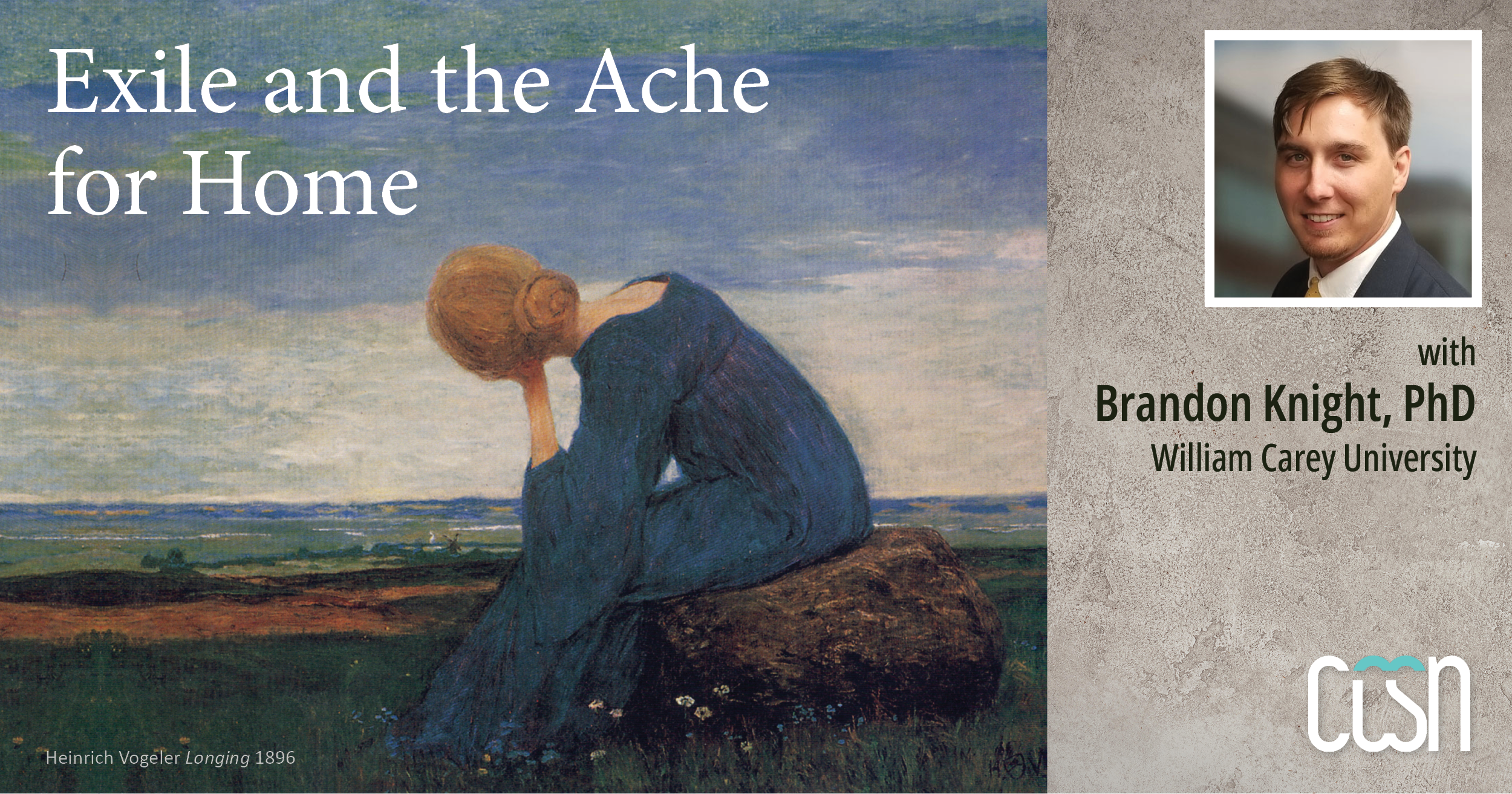
May 2026 Entry: “The Christian Journey of Longing (Sehnsucht)”
By Brandon Knight, PhD, William Carey University
Column Description: Have you ever felt disconnected? What if such moments of disconnect point to a greater reality? A lost memory of unity with creation only hinted through nostalgia. Often even as we experience nature and beauty, or a great fairy tale, we find ourselves at a type of distance—longing for more. Having felt a moment of fulfillment, we find that it is fleeting, only to be stripped away after the moment of insight occurs. As C.S. Lewis notes in The Weight of Glory, “We discern the freshness and purity of morning, but they do not make us fresh and pure” (p. 43). This column will be an examination of humanity’s spiritual longing and feelings of exile. Even more, we will trace how such experiences are made manifest through the words we speak making evident our longing for home.
May 2026
The Christian Journey of Longing (Sehnsucht)
Psalm 137 is a song of exile as the Israelites faced Babylonian captivity. Despite God delivering them from the Egyptians and using them to remove the evil Canaanites from the land, the promised descendants of Abraham were at a point of dissonance. Because of their sin and refusal to return to the Lord, he brought about exile. Just as the Canaanites were judged and driven from the land because of their evil, the Lord was now using a pagan nation—the Babylonians—to execute judgement through exile. Those who were once close to the One now were being ripped from the land and, more importantly, the God who saved and brought them to Zion. Nevertheless, those transplanted in a foreign land held on to the memory of Zion and sustained their hope of redemption through worship, song, and memory of God’s past actions. One day, He would show his faithfulness again. Until then, the Israelites could only hope and long for their homeland. Listen to the mixed pain and hope of the psalmist: By the rivers of Babylon we sat and wept when we remembered Zion. There on the willows we hung our harps, for there our captors requested a song; our tormentors demanded songs of joy: “Sing us a song of Zion.” How can we sing a song of the LORD in a foreign land? (Psalm 137: 1-4; BSB).
Longing is a rich scriptural concept; yet underdeveloped in Christian theology and praxis. Beginning in the Old Testament as the original image bearers—Adam and Eve—were exiled to the East of Eden, a longing to return has been ever present. Such a phenomenon recognizable is known popularly as nostalgia. Unknown to many, however, is the Greek etymology of the term. Nostos means “to return” or a “homecoming” of sorts, whereas Algos refers to pain, sorrow, or a longing. In other words, nostalgia means a longing to return home. In the exodus, God saved the Israelites from bondage to guide them to a land of their own. The land, however, was not an end to itself. Rather, it was a sign of the heavenly home in which God would live fully with his people (Rev. 21:3). An intermediate Eden, if you will, but only because it was pointing to something outside of itself.
The sin in Eden, of course, is the origin of this disconnect and pain (algos). Creation is alienated from the Creator due to rebellion via wayward desires and actions. The apostle Paul speaks clearly about creation’s tragic alienation even claiming that it too is demonstrating signs of longing for redemption. He writes, “We know that the whole creation has been groaning as in the pains of childbirth right up to the present time. Not only so, but we ourselves, who have the first fruits of the Spirit, groan inwardly as we wait eagerly for our adoption to sonship, the redemption of our bodies” (Rom. 8: 22-23; NIV). In other words, not only does scripture point to purpose in our groaning; to a similar degree, all of creation is signaling its desire for redemption to occur. If this ontological picture of a creaturely longing is correct, it is both advantageous and wise to better understand how we as humans interact and, at times, react to this deep desire.
Interacting with Nostalgia and Alienation: A Personal Story
Growing up, I was a homebody. I enjoyed staying home. Even when invited to a sleepover, I found myself wanting to go home early. Our house was not any more special than any other. Nevertheless, that does not mean it was not special. Our house was the first home on a dead-end road with plenty of space for adventure. My family, of course, added a special element to the space and place. They were the essential ingredient. My home was a place, but, even more, it consisted of the space where my people lived. This influence, albeit under the radar, was identity shaping.
Sadly, as a pre-teen, my parents went through a messy divorce. So messy, in fact, the judge required my parents to sell our home despite it being a bastion of numerous memories and experiences. And because of my age, the judge required me to stand in front of my mother and father and choose publicly which parent I preferred. A devastating and guilt-ridden experience. Not only was my family being taken from me without my permission, but this special place would also be taken, resulting in a unique identity crisis for myself.
After the divorce was finalized, I found new spaces to call home. However, none of these places had the same stability. Instead, like a ping pong ball, I bounced back and forth between parents. Both parents would remarry within a few years and with that two new “homes” were made available. Nevertheless, even with two new homes, neither would ever fully replace the special nature of our home before the divorce. To me, it was a special place of rest because we are all together. After the divorce, I felt disconnected and restless. Such feelings led me to drive by the old house to relive memories.
In the truest sense of the word, I was experiencing nostalgia as I would drive by our old home: longing to return home. Tragically, as time marched on, I began to realize that no healing was available for the ache to return to my once childhood home.
A Shared Experience
The story of my parents’ divorce is probably shared by several readers. But, even more, the experience of nostalgia is ubiquitous and pointing to something beyond itself. In Anthony Esolen’s informative book Nostalgia: Going Home in a Homeless World, he examines man’s plight in time, place, and culture which leads him to conclude that our quandary manifests in a number of ways.
Sharing the phenomenon of longing, he shares its label from a number of cultures.
He says, “The Welsh call it hiraeth, ‘longing,’ and in one of their folk songs they say that nobody can tell what exactly hiraeth is, but it brings both great joy and intense pain. … In Italian, you feel mancanza di casa, that is, you are ‘missing the home,’ literally the ‘house’; it is like a hole in your heart.”[1]
The beloved Christian figure C. S. Lewis wrote a great deal about “longing” as we have identified it above. In Lewis’s autobiography, Surprised by Joy, he endeavors to show the pervasiveness of longing throughtout his life even before converting. Early in the work, Lewis reminisces about the Castlereagh Hills, or what they called “the Green Hills,” which could be seen from the window of their home. The beauty of the landscape induced a sense of longing because the hills seemed “quite unattainable”. He said, “They taught me longing—Sehnsucht; made me for good or ill…a votary of the Blue Flower.”[2] Sehnsucht, which Esolen identifies as “seeking to see again,” becomes the theme of Lewis’s life.
In fact, Kilby, author of The Christian World of C. S. Lewis, contends that sehnsucht was the primary variable of Lewis’s work that allowed him to be so impactful to such a wide array of readers. For example, Kilby claims that “The culmination of Sehnsucht in the rhapsodic joy of heaven is, for me at least, the strongest single element in Lewis. … and suggests to me that Lewis’s apocalyptic vision is perhaps more real than that of anyone since St. John on Patmos.”[3]
Thus, this new column will be a journey to discover the purpose of these feelings of exile.
Notes
[1] Anthony Esolen. Nostalgia: Going Home in a Homeless World. Regnery Gateway, 2018. ix-x.
[2] C. S. Lewis. Surprised by joy. In The beloved works of C. S. Lewis. Inspirational Press: Edison, NJ. 6.
[3] Clyde Kilby. The Christian world of C.S. Lewis. Grand Rapids, MI: Wm. B. Eerdmans Publishing Co, 1964. 187.