
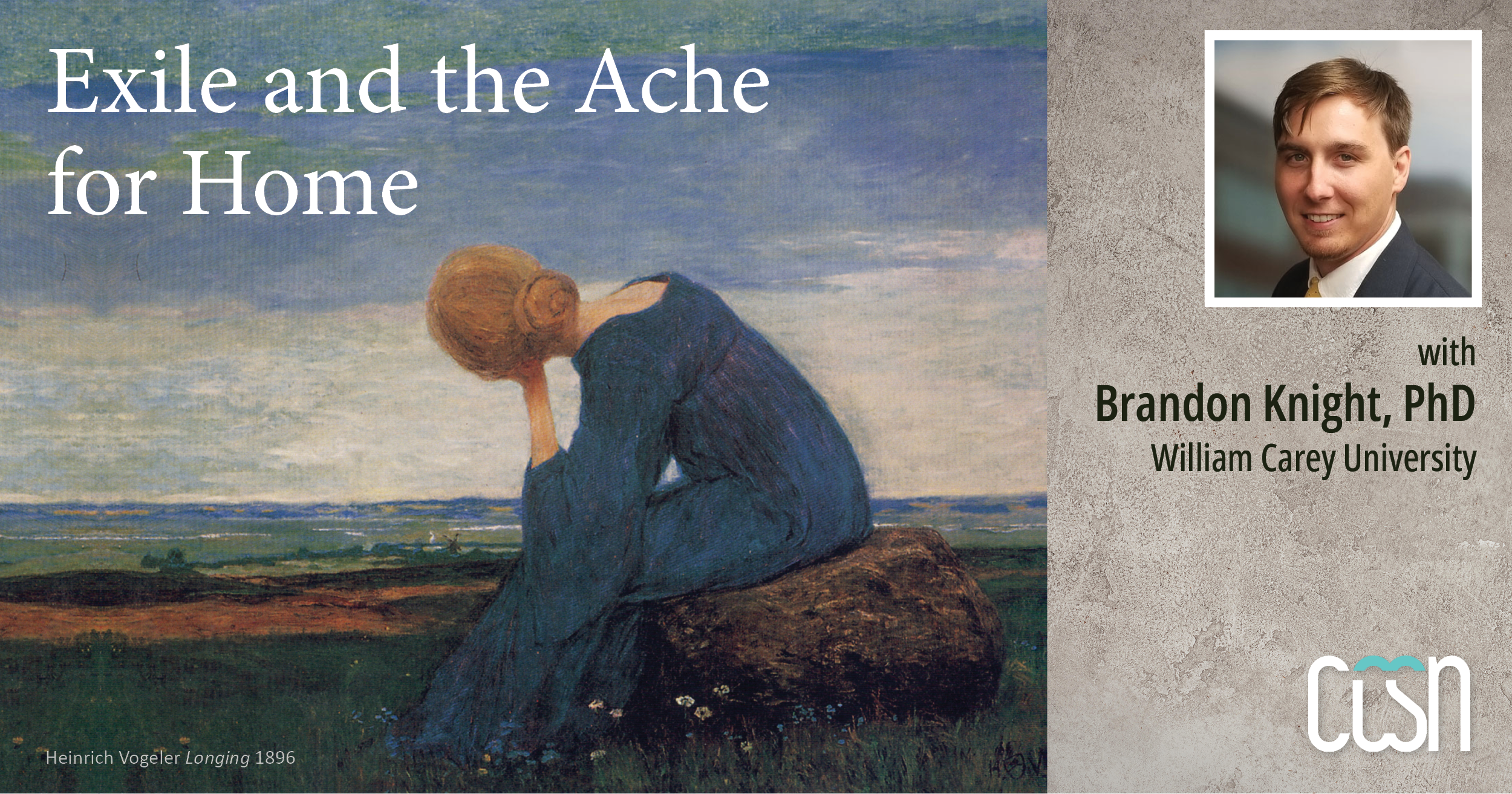
July 2026 Entry: “Lost and Searching for a Sign(post)” (Part 1 of 2)
By Brandon Knight, PhD, William Carey University
Column Description: Have you ever felt disconnected? What if such moments of disconnect point to a greater reality? A lost memory of unity with creation only hinted through nostalgia. Often even as we experience nature and beauty, or a great fairy tale, we find ourselves at a type of distance—longing for more. Having felt a moment of fulfillment, we find that it is fleeting, only to be stripped away after the moment of insight occurs. As C.S. Lewis notes in The Weight of Glory, “We discern the freshness and purity of morning, but they do not make us fresh and pure” (p. 43). This column will be an examination of humanity’s spiritual longing and feelings of exile. Even more, we will trace how such experiences are made manifest through the words we speak making evident our longing for home.
Lost and Searching for a Sign(post) (Part 1 of 2)
Near the end of his autobiography, Surprised by Joy, C. S. Lewis gives a potent metaphor as to how he felt about his life and experiences of sehnsucht. He says, “When we are lost in the woods the sight of a signpost is a great matter. … The whole party gathers round and stares.”[i] Many humans can attest to this sense of lostness with no ability to look heavenward and navigate via the stars. A signpost is crucial because, not only does it offer hope and sustenance, it provides direction.
But, what do we mean by a signpost? And what good is a signpost, if we don’t have a home?
As was discussed in Column 2, there are several competing narratives which seek to direct this phenomenon. Like Augustine, we must cultivate a refugee spirituality, which, as James K. A. Smith argues, means we are realistic about living on the journey and holding loosely to any tempting makeshift homes this side of heaven. For it was Augustine who said, “Our hearts are restless until they find rest in Thee.”
Who can teach us about these signposts and our shared exilic sense?
C.S. Lewis is a familiar name to many Christians and non-Christians. However, the specifics of his journey to Christianity are often missed especially as it relates to longing. In my mind, Lewis is the quintessential guide for rhetorical refugees on a spiritual journey pressured by various voices to settle down. His life was characterized by sehnsucht, yearning or craving. Even more, his quest to discover this exilic-ache led him to several competing (home)lands, ideologically speaking, until he, finally, found the way home.
The Saint of Longing: C. S. Lewis
In Lewis’s autobiography, Surprised by Joy, he endeavors to show the pervasiveness of sehnsucht throughout his life even before converting. He begins by discussing his childhood and how this longing uncontrollably challenged the everydayness of life.
For instance, Lewis reminisces about the Castlereagh Hills, or what they called “the Green Hills,” which could be seen from the window of their home. The beauty of the landscape induced a sense of longing because the hills seemed “quite unattainable.” He says, “They taught me longing—Sehnsucht; made me for good or ill…a votary of the Blue Flower.”[ii]
Elsewhere, Lewis speaks of his brother’s creation of a toy garden constructed from the lid of a biscuit can and moss and how this creation lifted his beliefs about Paradise and beauty. Of the toy model, he says “That was the first beauty I ever knew. What the real garden had failed to do, the toy garden did. It made me aware of nature…”[iii]
Thirdly, he reflects on how “the Idea of Autumn” in the Beatrix Potter’ books “troubled” him. In fact, he would return to the story often only “to reawaken it.”[iv] Lewis frames these experiences as a “glimpse” indicating insight into a reality that he normally was hindered from seeing.
Finally, he remembers being enraptured when reading poetry. At the sound of Balder the Beautiful’s death in Tegner’s Drapa, he says, “instantly I was uplifted into huge regions of northern sky.”[v] After this experience, Lewis recognized the impossibility of properly describing the phenomenon through language. Even more, it made him sick with desire.
Have you ever had a similar experience from the grandeur of nature, a beautiful sunset, the rustling of leaves in the Autumn, or the birth of a child? Do you suppose purpose behind such experiences? It took Lewis a lifetime to articulate the purpose to which he was called, which, in a sense, was to fulfill this longing.
Lost in the Woods
Similar occurrences continued later in Lewis’s life; however, much of the autobiographical work reminisces over experiences with school and various instructors who influenced his intellectual growth. Despite his family being Christian, Lewis recounts his dabbling in the occult adding to his “slow apostasy” from his childhood religion.[vi] Nevertheless, experiences of sehnsucht continued to shape what he would later call his inner life.
A major turning point for Lewis arose after seeing Arthur Rackham’s illustrations entitled “Siegfried and the Twilight of the Gods,” wherein he recounts a renewal experience of sehnsucht altering his life forever as the Joy felt in the moment connected back to the visions of his early childhood:
“And with that plunge back into my own past there arose at once, almost like heartbreak, the memory of Joy itself, the knowledge that I had once had what I had now lacked for years, that I was returning at last from exile and desert lands to my own country; and the distance of the Twilight of the Gods and the distance of my own past Joy, both unattainable, flowed together into a single, unendurable sense of desire and loss.”[vii]
From this point, Lewis embarked on a newfound quest to recapture this bittersweet experience. Interestingly, Lewis later found that these “stab[s] of Joy” could be conjured through other mediums.[viii] For instance, in studying Norse mythology Lewis recognized an object—Northerness—wholly absent from the childhood Christianity he knew. Nature also became another type of “medium” and “reminder” of past instances of Joy.[ix]
With this growing understanding of the desire, Lewis became increasingly aware of his fractured condition. Whereas his inner state was fueled by imagination, his outer self remained disconnected from the Thing which held his desires: “When I remember my outer life I see clearly that the other is but momentary flashes, seconds of gold scattered in months of dross, each instantly swallowed up in the old, familiar, sordid, hopeless weariness.”[x]
Eventually, Lewis would begin instruction at Bookham under the Great Knock, solidifying for him the rationalist perspective as well as “fresh ammunition” for his atheism.[xi]
Under the guidance of rationalism, however, he was led down the same path as Camus in that this sacred nostalgia was nothing more than illusory and childish fancy.
Notes
[i] Lewis, C. S. (2004). Surprised by joy. (pp. 1-130). In The beloved works of C. S. Lewis. Inspirational Press: Edison, NJ.
[ii] Lewis, p. 6.
[iii] Lewis, p. 6
[iv] Lewis, p. 11
[v] Lewis, p. 11
[vi] Lewis, p. 37
[vii] Lewis, p. 41
[viii] Lewis, p. 43
[ix] Lewis, p. 43
[x] Lewis, p. 66
[xi] Lewis, p. 78