
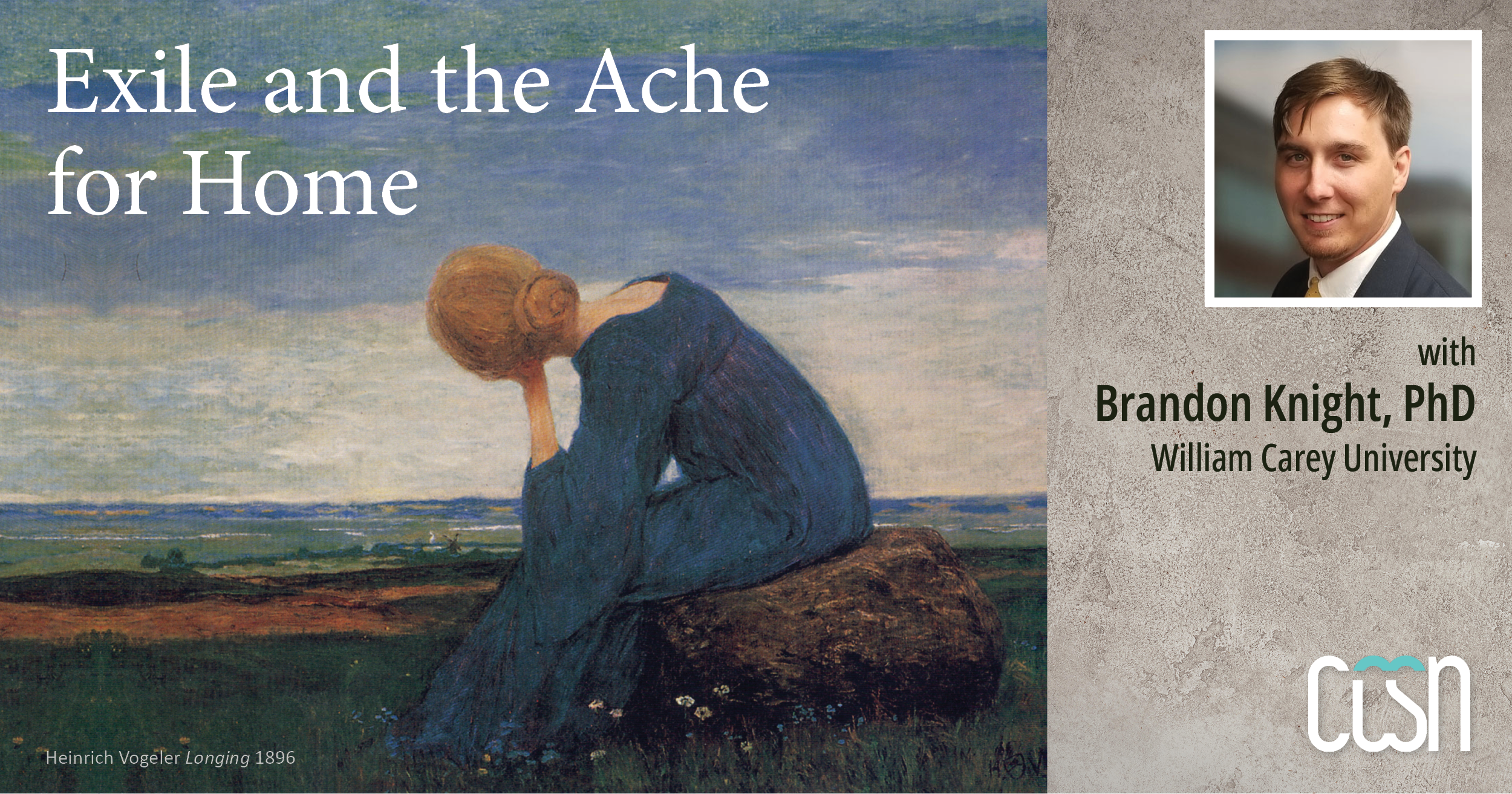
June 2026 Entry: “Places, Spaces, and Refugees”
By Brandon Knight, PhD, William Carey University
Column Description: Have you ever felt disconnected? What if such moments of disconnect point to a greater reality? A lost memory of unity with creation only hinted through nostalgia. Often even as we experience nature and beauty, or a great fairy tale, we find ourselves at a type of distance—longing for more. Having felt a moment of fulfillment, we find that it is fleeting, only to be stripped away after the moment of insight occurs. As C.S. Lewis notes in The Weight of Glory, “We discern the freshness and purity of morning, but they do not make us fresh and pure” (p. 43). This column will be an examination of humanity’s spiritual longing and feelings of exile. Even more, we will trace how such experiences are made manifest through the words we speak making evident our longing for home.
June 2026 | May 2026
Place shapes its inhabitants—for good or for ill.
When I began my undergraduate career in Mississippi, the university campus itself was a challenge in that it was expansive, complex, and a maze to newcomers. As is the case at most universities, parking decals were outrageously priced and afforded you a long walk from the nether regions of campus property. With the challenge and responsibility of new college classes, I truly was in an unknown place. However, at a certain point, campus became special. I belonged.
The university’s architecture and beauty had a certain allure that communicated the-then nearly century old history of education. By the end of my undergraduate career, the education received and experiences had dramatically impacted my identity. The unknown was now known—or at least I believed it to be.
I returned for graduate school five years later hoping to pick back up the same friendships, routines, and allure of my undergraduate career. However, what I believed to be my own stomping ground was foreign. Even campus had changed. The landscape was slightly altered due to a past tornado. Some familiar buildings were completely renovated and home to different disciplines, adding to the foreign nature of the campus I once knew.
I was somehow a foreigner in the same place that I once experienced belonging. Eventually, the realization set in, namely that campus would never really be the same as it was during my undergraduate years. A return was impossible.
Is this longing a blessing or a curse?
We are dis-placed by time, as memory and identity drift together on—the fragments refuse to bind.
Some, however, are displaced physically and uprooted from their homes and forced to live like strangers elsewhere.
The Uncanny: Modern-Day Refugees Return Home
Veronica Della Dora, when writing for Cultural Geography, speaks of the rhetoric of nostalgia and its effect on our “cartography of memory.”[i]
Dora outlines the historic happenings following World War II with the nationalization of Egypt and exiling of the then-European born Alexandrians. More specifically, she discusses the historic city of Alexandria and those exiles who, decades later, made a pilgrimage back to the city of their birth.
Not surprisingly, their return “ends in a deep disappointment…” because they arrive in hopes of having the pangs of their exile wiped away; yet, what they truly found was uncanny.[ii] For example, some returned to personal homes or shops; however, instead of seeing familiar faces, someone unknown now lived or worked there.
A welcome home was impossible. In fact, they were rejected.
Freud originally coined the term “uncanny” to denote feelings of the unfamiliar or a feeling that is literally translated from German as unhomely.[iii] Dora concludes that many of these exiles are haunted by “the gap between imagination and reality…,”[iv] which is to say the Alexandria of the past will never match the Alexandria in the present. In fact, the obvious connections between the two force us deeper into alienation and estrangement.
Is this longing a blessing or a curse?
Needing a Guide for Nostalgia
In On the Road with Saint Augustine: A Real-World Spirituality for Restless Hearts, James K. A. Smith looks for various guides to aid travelers with this restlessness. He first discusses French Philosopher Albert Camus.
Camus, Smith argues, takes a Sisyphean approach meaning that “joy is predicated on the impossibility of arrival.”[v] In the Greek myth, Zeus punishes Sisyphus to eternally push a boulder up a hill only to have it immediately roll back down. The work is never complete. Joy is never found.
Camus, in fact, states: “All Sisyphus’ silent joy is contained therein. His fate belongs to him. His rock is his thing.” (Smith, p. 39) From this perspective, longing is a curse because it is illusory and insatiable. To paraphrase Camus, no home exists.
Smith, however, argues that Camus’ honesty reveals the blessing. “Not-at-home-ness could be the place from which you finally hear the call to be yourself.”
This call, Smith argues, was discovered in the life of Augustine. As Smith demonstrates, even Augustine’s rising triumph in Rome and Milan demonstrates that he doesn’t ever really find his place to belong.
That is, until he converts to Christianity.
Unlike Camus, Augustine’s dis-placement is revealed to be a blessing because he discovers through Christianity that his home is elsewhere and adopts, what Smith calls, a “refugee spirituality.”[vii]
The Refugee and Rhetoric
The refugee is different than the pilgrim. Due to disruption, refugees are displaced exiles who lack both a home and a set physical destination. The un-homely nature of this world is evident to them. Thus, they remain on the road and continue to search for the place where they will be welcomed.
The danger for the refugee is the deceit of believing this world is their final home. Smith writes, “What we long for is an escape not from creaturehood but from the fraught, harrowing experience of being human in a broken world. What we’re hoping for is a place where a sovereign Lord can assure us, ‘You’re safe here.’”[viii]
Augustine’s vision of the Christian life as refugees or sojourners encompasses more than spirituality, however. It is also rhetorical. We inevitably are met by various voices and ideologies persuading us as to how we should react. The refugee’s response to longing matters because by it they are pointed in various directions for home.
Like Camus, do we believe our longings for a home to be illusory? Will we believe that politics can reshape this world into home? Or like Augustine, do our longings orient us on a sacred path that brings us Home.
To Smith, we can be reshaped by this exilic ache—”unsettled yet hopeful, tenuous but searching, eager to find the hometown we’ve never been to.”[ix]
Maybe a re-turn is possible.
Notes
[i] Dora, Veronica Della. “The rhetoric of nostalgia: postcolonial Alexandria between uncanny memories and global geographies.” cultural geographies 13, no. 2 (2006): 207-238. 219.
[ii] Dora, 220.
[iii] Freud, Sigmund. “The Uncanny.” Accessed here: web.mit.edu/allanmc/www/freud1.pdf
[iv] Dora, 220.
[v] Smith, James K. A. “On the road with Saint Augustine: A real-world spirituality for restless hearts.” Brazos Press, (2019): 38.
[vi] Smith, 42.
[vii] Smith, 50.
[viii] Smith, 49.
[ix] Smith, 50.