
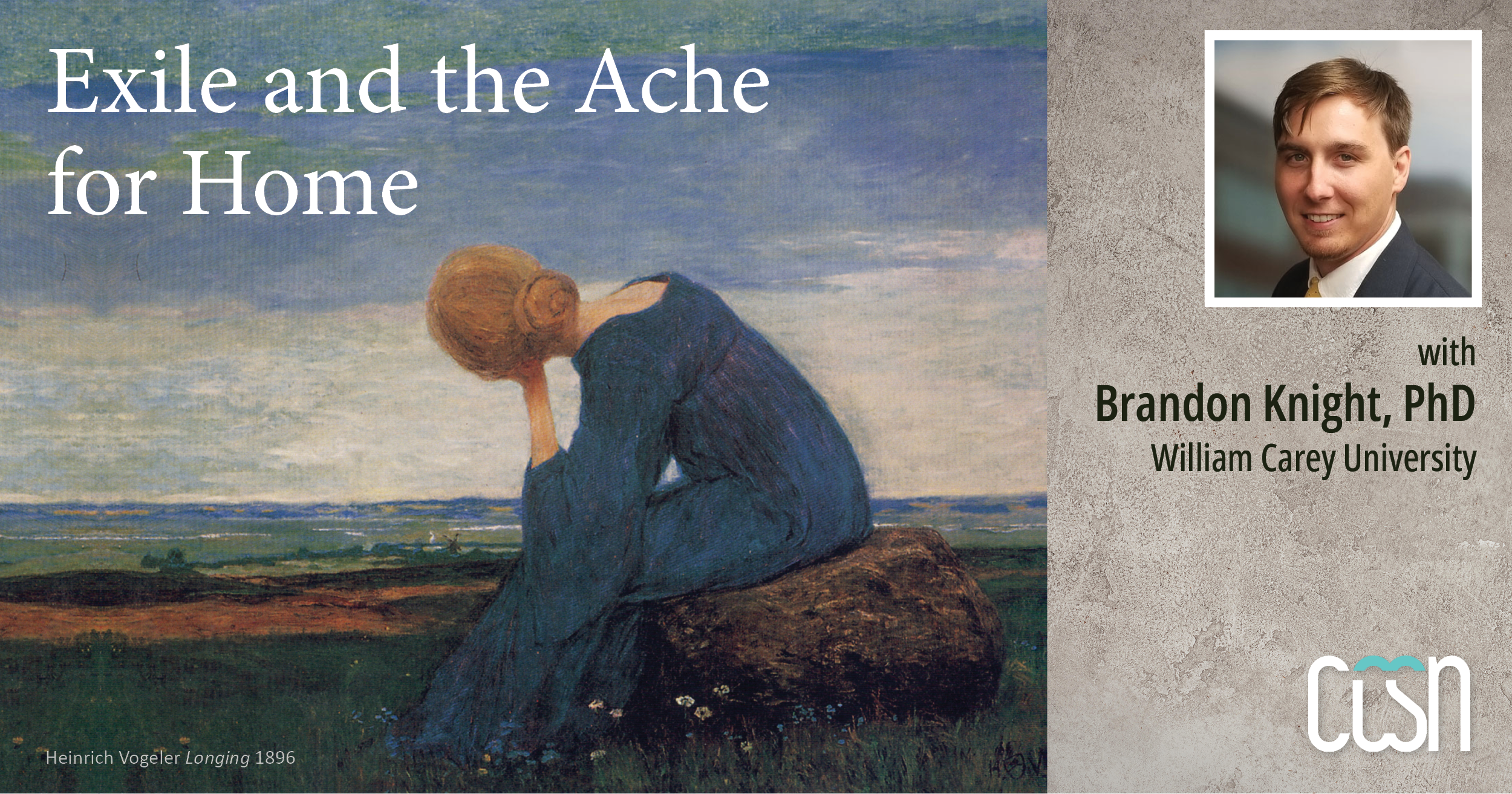
By Brandon Knight, PhD, William Carey University
Column Description: Have you ever felt disconnected? What if such moments of disconnect point to a greater reality? A lost memory of unity with creation only hinted through nostalgia. Often even as we experience nature and beauty, or a great fairy tale, we find ourselves at a type of distance—longing for more. Having felt a moment of fulfillment, we find that it is fleeting, only to be stripped away after the moment of insight occurs. As C.S. Lewis notes in The Weight of Glory, “We discern the freshness and purity of morning, but they do not make us fresh and pure” (p. 43). This column will be an examination of humanity’s spiritual longing and feelings of exile. Even more, we will trace how such experiences are made manifest through the words we speak making evident our longing for home.
August 2026 | July 2026 | June 2026 | May 2026
Lost and Searching for a Sign(post) (Part 2 of 2)
In Part 1 of this column, I discussed C. S. Lewis’s earliest experiences of sehnsucht and how both the pain and sweetness acted as ruptures that inevitably led to feelings of dislocation and exile. Yet, despite being a devoted follower of this sacred longing, he did not at first discern a clear way to seek it, and thus came to rely on makeshift signposts, such as rationalism.
His problem, as we will discover, was his hyperfocus on the longing itself as opposed to the aim, or telos, of the experience.
Rationalism and the Degradation of Desire
Even rationalism did not settle his feelings of exile. In fact, it frustrated him because rationalistic realism required a rejection of any aspect beyond the physical senses. Thus, this sacred longing had to be demythologized and chalked up to a mere subjective experience.
When faced again by this exilic ache unexpectedly, however, his heart and mind were persuaded of the world’s enchantment. The home of rationalism led back to disenchantment, stifling this sacred longing and causing him great stress. For instance, he says, “Such, then, was my position: to care for almost nothing but the gods and the heroes, the garden of the Hesperides, Launcelot and the Grail, and to believe in nothing but atoms and evolution and military service. At times the strain was severe.”[i]
This fractured state led to a crisis wherein he rejected Christianity.
Following his service in World War I, he befriended Owen Barfield who persuaded him toward idealism which opened the door to re-enchantment and stoked Lewis’ sacred longing.
At that time, it made perfect sense because it seemed to fully reconcile his fractured state. In this philosophy, he says, “The Absolute was ‘there,’ and that ‘there’ contained the reconciliation of all contraries, the transcendence of all finitude, the hidden glory which was the only perfectly real thing there is.”[ii]
Again, his imagination is captured by Alexander’s Space, Time, and Deity in which a great discovery regarding this longing comes to light. The experience of longing itself was not the point. Rather, it was a signpost guiding him to something “other and outer.”
By focusing on the longing itself, he was blinded to its purpose. He instead needed to look at it from a different angle: “This discovery flashed a new light back on my whole life. I saw that all my waitings and watchings for Joy, all my vain hopes to find some mental content on which I could, so to speak, lay my finger and say, ‘This is it,’ had been a futile attempt to contemplate the enjoyed.”[iii]
Lewis had been searching in vain for the mere objects that brought about the desire rather than the Thing to which the desire was pointing. In other words, he finally understood that the items which brought on his longing like mythology, or nature, were “not the wave but the wave’s imprint on the sand.”[iv]
He finally understood: sehnsucht was a means to an end. A signal from beyond resulting in a journey upon a “road out of the self.”[v]
He had no idea where the road would lead, but, like any refugee, the destination was “unknown, undefined, desired.”[vi]
As I will discuss in the next column, Lewis ultimately found the Christian story to be “the summing up and actuality” of this sacred longing.
Learning How to See Sehnsucht
In Meditation in a Toolshed, Lewis expounds these differences through two metaphors of observation—looking along and looking at—which, in many ways, sheds light on his greatest moments of fracture.
In this essay, he recounts an experience of entering a tool shed and shutting the door only to notice a ray of light. At first, he was able to see many things in the toolshed by “looking along” the ray. However, when he attempted to gain greater sight by looking straight at the light, “the whole previous picture vanished.”[vii] To further illustrate this point, Lewis offers an example of lovers:
“A young man meets a girl. The whole world looks different when he sees her. Her voice reminds him of something he has been trying to remember all his life. … Now comes a scientist and describes this young man’s experience from the outside. For him it is all an affair of the young man’s genes and a recognized biological stimulus.”[viii]
How does this relate to his experience of sehnsucht? Well, as shown through his story, most of Lewis’s confusion and angst occurred from looking at and attempting to rationalize this yearning. In doing so, his understanding was blinded.
Lewis’s argument is not in favor of simply one of the two forms of seeing. Instead, he notes how “looking along” is no longer valued due to our rationalistic tendencies, especially in relation to religion or the metaphysical.
From a rationalistic standpoint, Lewis’s experiences of sehnsucht might, by some, be chalked up to escapism or a biochemical imbalance. We are unable to see its significance. However, if we look along sehnsucht, we might find a sign to guide us home.
As he says in Surprised by Joy, these experiences were signposts to aid. Each glimpse was nourishment and sustenance to continue the search despite being lost in the woods. However, once the road was found, the sign’s true value was discovered: “It was valuable only as a pointer to something other and outer.”[ix]
Our longings and nostalgia are signposts to the heavenly city. Don’t doubt and cover up the feelings of fracture. Instead, re-configure how you see your lostness, like Lewis. Like all signs, they exist to point beyond themselves. They are stand-ins.
Our longing is not the point. Home is. We must, however, beware of the perilous journey. Competing voices affect our progress. Lewis regressed through atheism, rationalism, the occult, and idealism. Sehnsucht kept signaling the way until his eyes refocused on the destination.
“But when we have found the road and are passing signposts every few miles, we shall not stop and stare…though the pillars are of silver and their lettering of gold. ‘We would be at Jerusalem.’”[x]
Lewis models the journey of the rhetorical refugee who is dislocated by pangs of exile and seeks to find a place of belonging. His testimony is that by looking along our sense of exile, we will find the way forward and, in the end, a destination.
Notes
[i] Lewis, C. (2004). Surprised by joy. (pp. 1-130). In The beloved works of C. S. Lewis. Inspirational Press: Edison, NJ. 96.
[ii] Lewis, 115.
[iii] Lewis, 120.
[iv] Lewis, 121.
[v] Lewis, 121.
[vi] Lewis, 121.
[vii] Lewis, C. (1970). God in the dock: Essays on theology and ethics. The Trustees of the Estate of C. S. Lewis. 212.
[viii] Lewis (1970), 212.
[ix] Lewis (2004), 130.
[x] Lewis, 130.